
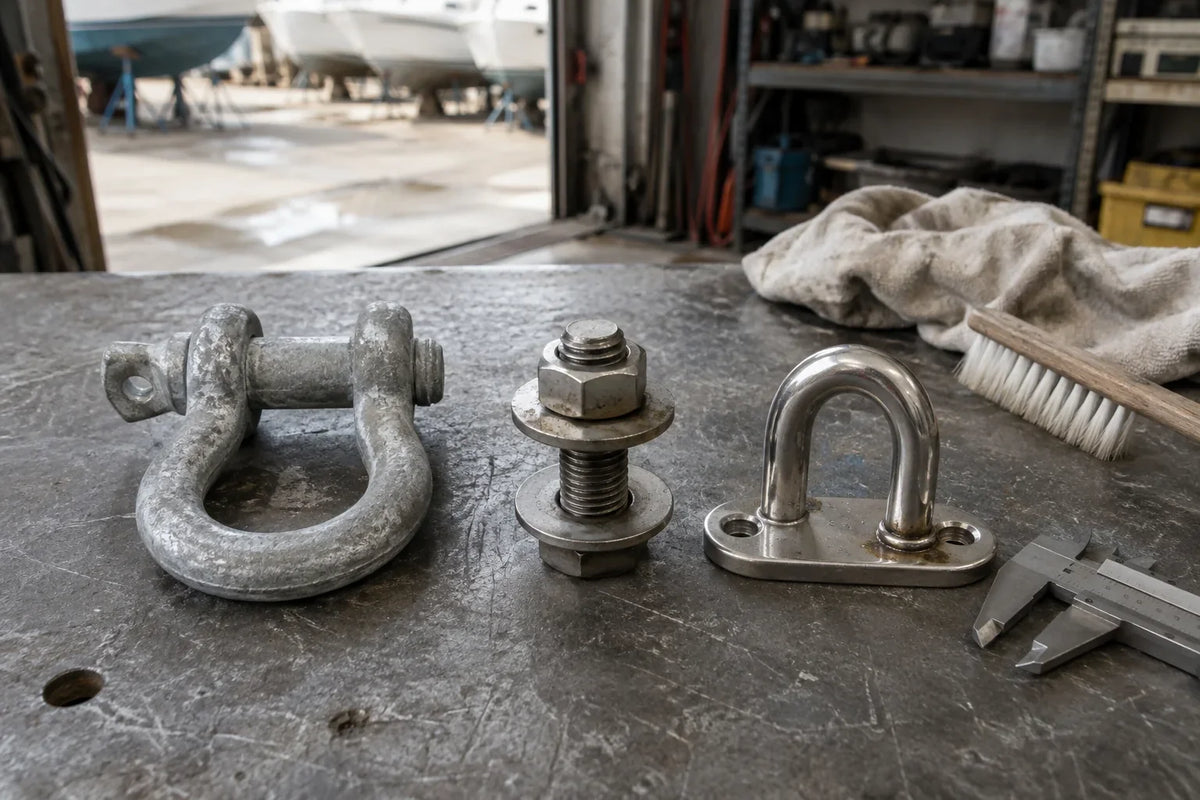
Cover image note: This AI-generated technical illustration compares representative marine-hardware finishes. Metal grade cannot be confirmed by color, polish, magnet response or the image alone; verify documentation for the actual part.
Editorial scope: This guide explains general material-selection principles for recreational and light-commercial marine hardware. It does not replace a product drawing, load rating, vessel-builder instruction or inspection by a qualified marine professional.
“Marine grade” is a useful starting point, but it is not a complete specification. A cleat inside a dry cabin, a hinge washed by salt spray and an anchor that repeatedly contacts the seabed do not ask the same things of a material. The right choice depends on exposure, load, geometry, finish, adjacent metals and the maintenance the owner is prepared to do.
That is why the practical question is not simply “Is 316 better than 304?” It is: Which material, in this particular part and location, gives an acceptable combination of corrosion resistance, strength, inspection access, appearance and cost?
The short answer
- 304 stainless steel is widely used, easy to fabricate and often appropriate for freshwater, interiors and less aggressive exterior locations.
- 316 stainless steel contains molybdenum and generally offers better resistance to chloride-related pitting and crevice corrosion, making it a common choice for exposed coastal hardware.
- Hot-dip galvanized steel protects carbon steel with a zinc coating. It remains a practical choice for many anchors, chains, trailers and heavy components, provided the coating is suitable for the environment and is inspected as it wears.
None of the three is maintenance-free. “Stainless” does not mean stain-proof, and a zinc coating cannot protect forever after it has been worn away.
304, 316 and galvanized steel at a glance
| Question | 304 stainless | 316 stainless | Hot-dip galvanized steel |
|---|---|---|---|
| Typical reason to choose it | Good general corrosion resistance and value | Improved resistance in chloride-rich exposure | Cost-effective protection for larger steel components |
| Common marine uses | Interior fittings, freshwater hardware, protected accessories | Exposed deck fittings, rail hardware, selected fasteners and anchors | Anchor chain, selected anchors, trailers and dock hardware |
| What to inspect | Tea staining, pitting, crevices and contamination | Salt deposits, pitting, crevices, welds and dissimilar-metal contact | Coating loss, red rust, abrasion and damaged edges |
| Frequent misunderstanding | That it is unsuitable anywhere near a boat | That it cannot rust or corrode | That a shiny or intact-looking surface proves the coating is sound everywhere |
Start with the exposure, not the alloy name
A part can see several different environments during one trip. A deck fitting may be dry most of the day, covered in salt spray in the afternoon, then left beneath a wet line overnight. That wet-and-dry cycle can be more demanding than an occasional rinse. The most important questions are usually these:
- Is the boat used in freshwater, brackish water or seawater?
- Is the fitting indoors, exposed to spray, intermittently immersed or continuously submerged?
- Can salt and water drain away, or will they remain trapped under a base, washer or gasket?
- Will the surface be abraded by chain, rope, sand or tools?
- Which other metals will touch the part?
- Can the owner reach, clean and inspect it?
Two fittings made from the same alloy may age very differently if one drains and receives fresh air while the other sits in a damp, oxygen-poor crevice. Material grade matters, but design and installation often decide whether the grade can perform as intended.
Where 304 stainless steel makes sense
Type 304 is the familiar chromium-nickel stainless used across food equipment, architecture, transport and general hardware. It develops a thin passive surface film that helps resist corrosion. In many boat applications it offers a sensible balance of availability, appearance and cost.
It can be a reasonable candidate for cabin hardware, protected lockers, freshwater boats, accessories that are rinsed and dried, and components with limited salt exposure. The word “candidate” matters: a part still needs the correct dimensions, strength, finish and installation method.
In chloride-rich environments, 304 is more vulnerable than 316 to localized corrosion. Warning signs include small rust-colored spots, pits near edges or fasteners, and staining where water remains trapped. Surface contamination from ordinary carbon-steel tools can also leave rust marks that are blamed incorrectly on the stainless itself.
What 316 stainless steel changes
Type 316 adds molybdenum to the chromium-nickel system. The International Molybdenum Association explains that this addition improves resistance to localized corrosion in chloride-bearing environments. That is the technical reason 316 is frequently specified for coastal architecture and exposed marine fittings.
For hardware that receives regular salt spray, 316 is often the more conservative starting point. AirowMarine’s deck and hull hardware range includes many 316 stainless fittings intended for buyers who place a high priority on corrosion resistance and a polished finish.
But 316 is not a promise that corrosion cannot occur. Salt can concentrate beneath deposits. Tight joints can create crevices with restricted oxygen. Dissimilar metals can create galvanic conditions. Welding, fabrication, surface contamination and finish quality can all affect service behavior. Rinsing and inspection still belong in the maintenance plan.
316 versus 316L
The “L” means low carbon. It is especially relevant where welded sections may otherwise become sensitized in corrosive service. It should not be presented as a universal upgrade that automatically makes every small fitting stronger or more corrosion-resistant in every situation. If a product listing names 316L, the claim should come from traceable material information for that product rather than from appearance alone.
Where galvanized steel remains useful
Hot-dip galvanizing places a zinc coating over steel. The zinc provides barrier protection and can also protect exposed steel sacrificially around limited coating damage. This makes galvanized construction useful for many large or wear-prone components where stainless cost, finish or fabrication is not the deciding factor.
Galvanized anchors and chains are common for good reason. They can offer a practical service life and are easier to inspect once coating wear becomes visible. The trade-off is that seabed contact, chain movement and handling can gradually remove zinc. Splash zones are also demanding because wet-and-dry cycles repeatedly expose the coating to salts and oxygen.
The correct response is not “galvanized is cheap and bad” or “stainless is always superior.” It is to inspect the coating, understand the duty cycle and replace or re-galvanize components before section loss becomes unacceptable.
Choose by component and failure consequence
Cleats, hinges, latches and rail fittings
For exposed hardware, 316 is often attractive because the fitting is touched frequently, remains visible and may trap spray around fasteners. Confirm the base dimensions, hole spacing, fastener material and backing arrangement. A polished alloy cannot compensate for an undersized backing plate or a fitting used outside its rated purpose.
Anchors and ground tackle
Material is only one part of an anchoring system. Anchor geometry, weight, seabed, rode, scope and setting technique are usually more important to holding than surface finish. A 316 stainless delta-style anchor may suit a buyer who wants this geometry and finish, but its size still has to match the vessel and operating conditions. The connecting hardware, including a correctly selected bow shackle, must be checked as part of the same load path.
Interior and freshwater hardware
304 can be a rational choice where exposure is mild and inspection is easy. Paying for 316 everywhere may add cost without solving the real risk. Conversely, a nominally protected fitting beside a wet locker or poorly ventilated bilge may see harsher conditions than its location suggests.
Drainage and below-waterline systems
Do not select a thru-hull, drain or seacock by alloy name alone. Location relative to the maximum heeled waterline, valve requirements, thread compatibility, hose connection, backing, access and applicable standards all matter. See the marine plumbing and ventilation range as a product starting point, then verify the installation with the vessel builder or a qualified installer.
Five details that often matter more than the marketing copy
- Drainage: A base that traps saltwater creates a different exposure from one that drains and dries.
- Fastener compatibility: Mixed metals and a conductive electrolyte can create galvanic corrosion. Isolation methods must suit the specific assembly.
- Finish and fabrication: Embedded iron, rough welds and unfinished crevices can become corrosion initiation points.
- Mechanical data: Material grade does not prove working load, fatigue life or fitness for lifting, towing or life-safety use.
- Access: Hardware that cannot be seen or serviced tends to remain neglected until a small problem becomes an expensive one.
A practical inspection routine
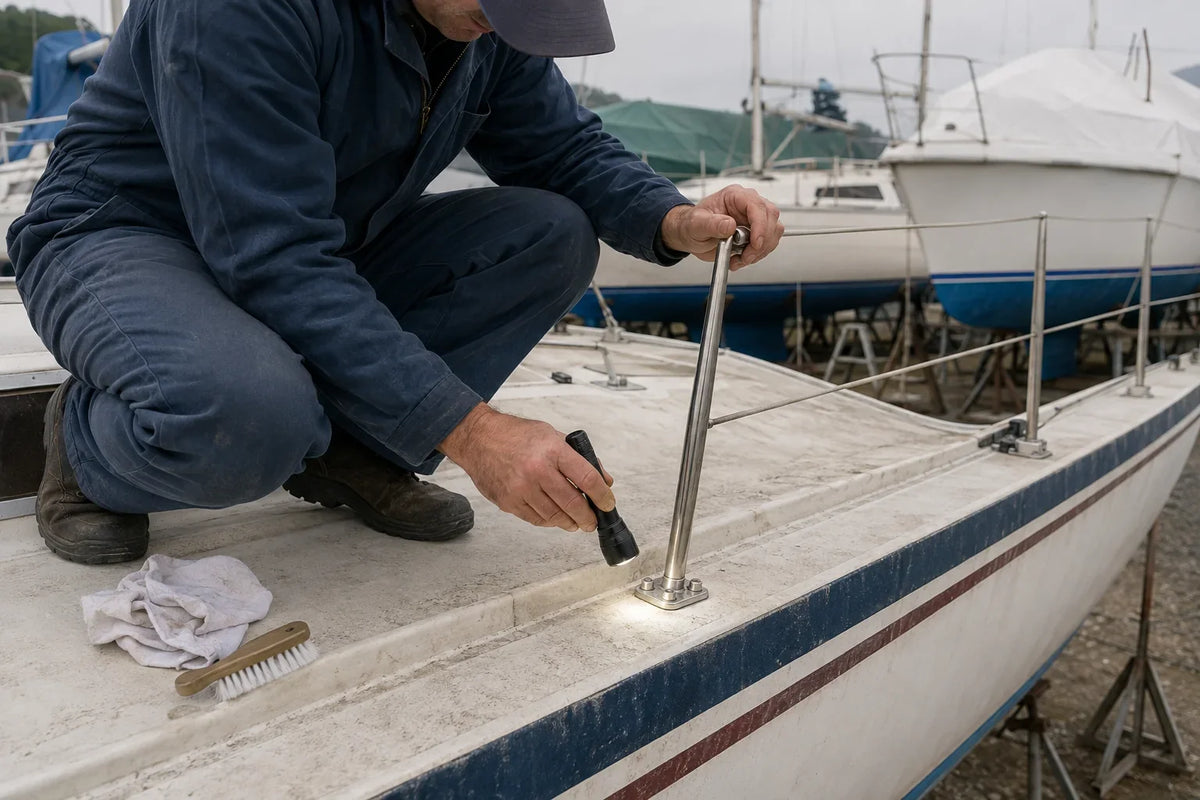
Rinse exposed hardware with fresh water when practical, particularly after heavy salt exposure. Remove deposits with a cleaner suitable for the finish and follow the product manufacturer’s instructions. During inspection, look around fasteners, undersides, welds, hinge pins and other crevices rather than judging only the polished face.
For galvanized parts, look for coating wear, red rust and abrasion at contact points. For stainless parts, investigate new staining rather than polishing it away and forgetting it. If a fitting carries a critical load, shows cracking or deformation, or sits in a below-waterline system, take it out of service until a qualified person has assessed it.
Questions to ask before ordering
- What exact material grade is stated for this item?
- Are dimensions and mounting-hole spacing available?
- Is a working-load or test value actually supplied for the exact model?
- Will the part touch aluminum, bronze, carbon steel or another metal?
- Does the installation trap water or prevent inspection?
- Is the item intended for the proposed use, or does it only look similar?
When those answers are missing, ask before ordering. AirowMarine can help compare listed dimensions and material information, but vessel suitability and safety-critical installation remain the responsibility of the owner and qualified installer.
Technical references
- International Molybdenum Association: molybdenum-grade stainless steel FAQ
- IMOA and ISSF: corrosion resistance of stainless steels
- Outokumpu: stainless steel corrosion guides
- American Galvanizers Association: hot-dip galvanized steel in water
- American Galvanizers Association: galvanized steel in seawater splash zones
References describe general material behavior. They do not certify an AirowMarine product. Product-specific certificates and ratings apply only when they are supplied for the exact item.

Leave a comment
This site is protected by hCaptcha and the hCaptcha Privacy Policy and Terms of Service apply.