
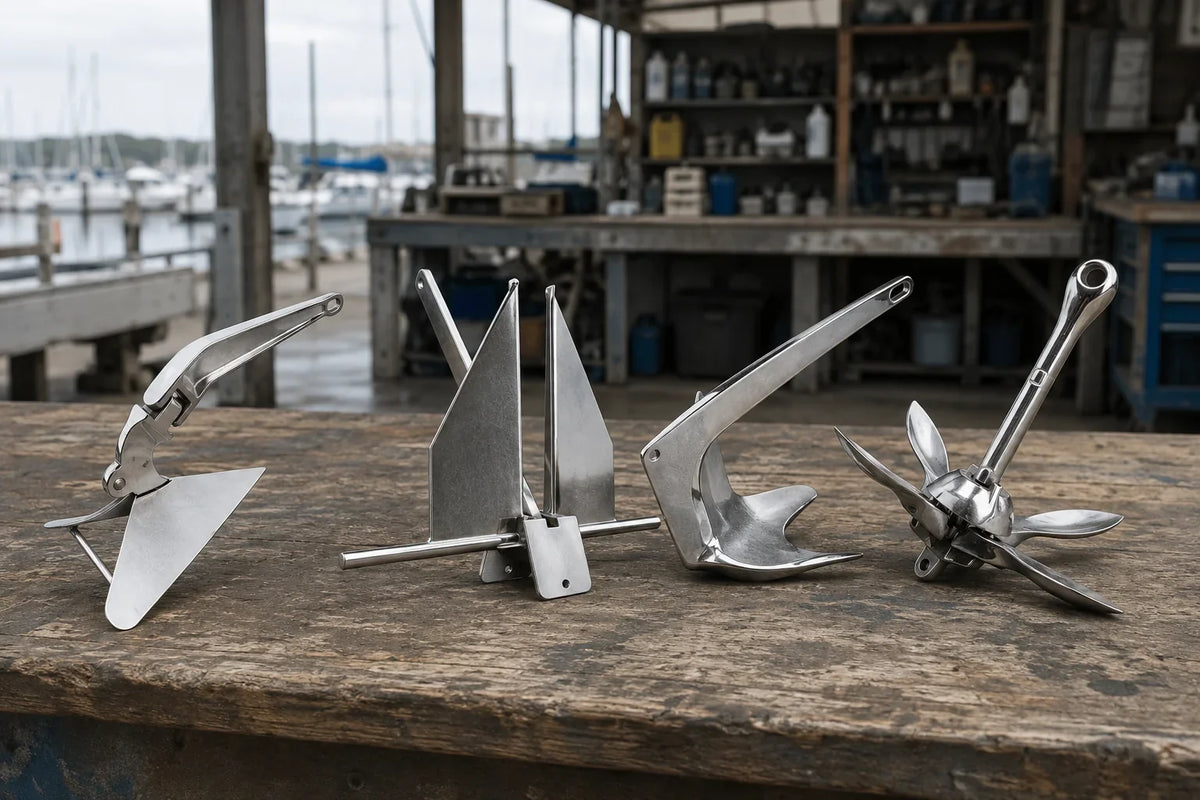
Cover image note: This AI-generated technical illustration compares four reference-based anchor forms on a workbench. It does not establish holding power or suitability for a seabed; use maker data and local anchoring guidance.
There is no single “best anchor” independent of bottom, boat, rode and weather. Anchor shape matters, but the system succeeds or fails through selection, deployment, scope, setting, veering room and the crew's ability to verify that the boat is holding.
This comparison focuses on four common geometries. It does not assign a universal holding-power number, because published ratings depend on the exact model, size and test conditions.
Plow or delta-style anchors
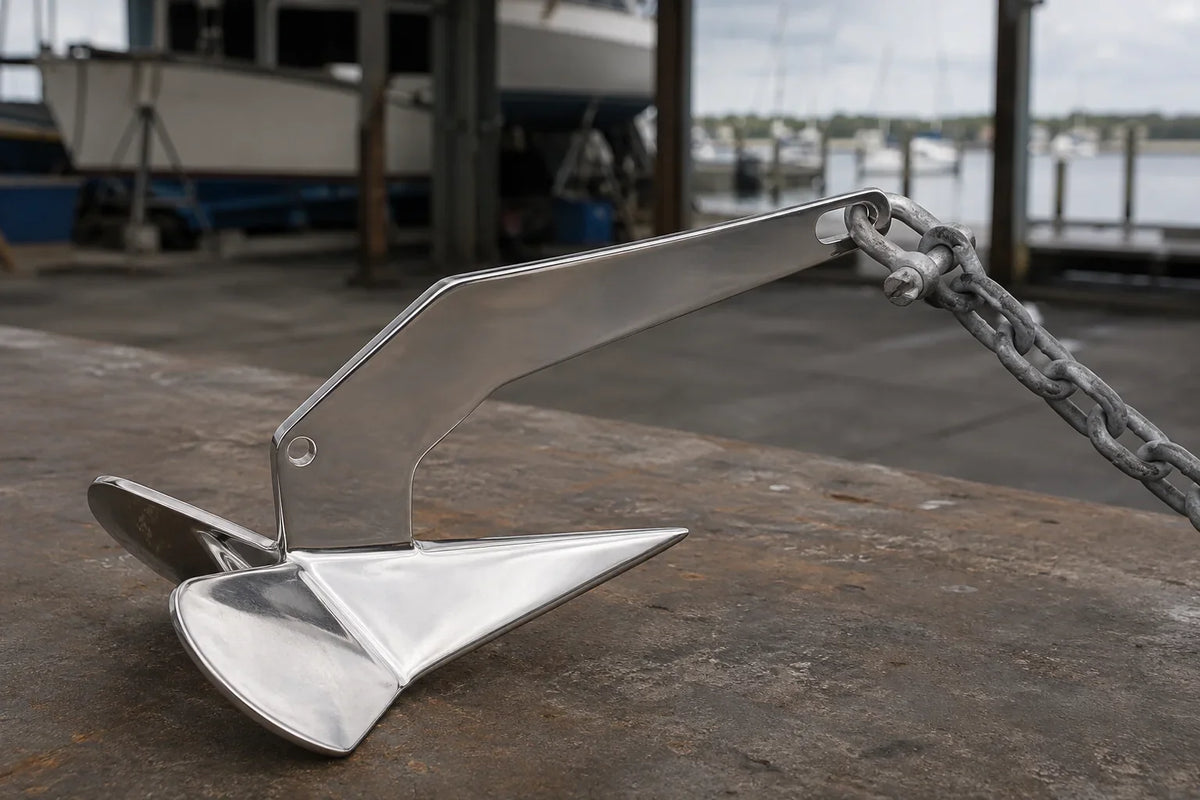
A plow-shaped anchor uses a weighted or shaped toe and a broad fluke to penetrate and remain buried as load changes. Many are designed to self-right and stow on a bow roller, but roller fit varies. Check shank length, roll-bar or shoulder clearance, point position, anchor-lock compatibility and whether the anchor can strike the hull.
Plow forms are often chosen as general-purpose primary anchors, yet bottom composition still controls performance. Weed, very hard bottoms and debris can prevent initial penetration. The AirowMarine plow form and the catalog's delta-style forms illustrate related but not identical geometries. Compare the exact maker's size guidance to vessel data.
Fluke or Danforth-style anchors
Two wide flukes pivot relative to the stock and shank. This geometry can develop a large buried area in suitable sand or mud and often stores relatively flat. It needs room for the flukes to articulate and a clean approach to the bottom. Stones, heavy weed or a fouled rode can prevent setting.
A fluke anchor's apparent width is not a size recommendation. Use the manufacturer's chart and inspect the pivot, stock and connection. AirowMarine's Danforth-style example is one product form; do not transfer its dimensions or guidance to another design.
Claw or Bruce-style anchors
The one-piece claw shape is commonly valued for simple construction and its ability to reset after some direction changes. It may fit certain bow arrangements well, but it occupies a different envelope from a plow and can behave differently across bottoms. Confirm both selection guidance and actual roller fit.
See the AirowMarine claw-form range only as a geometry reference until you have checked the live size table and the requirements of your boat.
Folding grapnel anchors
A grapnel has several arms and is compact when folded. Small versions are commonly considered for dinghies, kayaks or temporary, light-duty uses where stowage matters. Its ability to hook rock or structure can also make recovery difficult and damage sensitive habitat. It is not automatically a substitute for a properly sized primary anchor.
If considering a folding grapnel form, define the small-craft use, bottom, retrieval method and manufacturer limits first.
A comparison that is more useful than “which one holds most?”
| Question | Why it matters |
|---|---|
| What bottoms will you actually encounter? | Penetration and buried area change with sand, mud, weed, rock and debris. |
| Is this the primary, stern or emergency anchor? | The duty affects selection, stowage and rode planning. |
| Can the boat deploy and recover it safely? | Weight, roller fit, windlass compatibility and crew reach all matter. |
| What happens when wind or current reverses? | The anchor may need to remain buried or reset as load direction changes. |
| What is the full rode system? | Chain, rope, connectors, scope and chafe protection affect setting and shock loading. |
Build the complete system with our ground-tackle guide, then plan a controlled set-and-retrieval practice in familiar water. Confirm position using more than one visual or electronic reference and allow for swing.
Bottom care is part of seamanship
Avoid seagrass, coral and restricted areas. Use charts, local rules and designated moorings where available. The RYA's anchoring-with-care guidance explains how selection of location and technique reduces damage.
How to use selection charts responsibly
Manufacturer charts are model-specific inputs, not interchangeable tables. Use the boat's loaded displacement, windage and service conditions—not length alone—and apply any cruising or storm guidance supplied by that maker. The Fortress selection guide is an example of product-specific sizing information; a value from it should not be applied to a different anchor.
Takeaway: Choose a documented anchor that suits the likely bottom and duty, confirm it fits the bow system, pair it with a compatible rode, and verify every set. Material finish is secondary to geometry, sizing, deployment and seamanship.

Leave a comment
This site is protected by hCaptcha and the hCaptcha Privacy Policy and Terms of Service apply.