
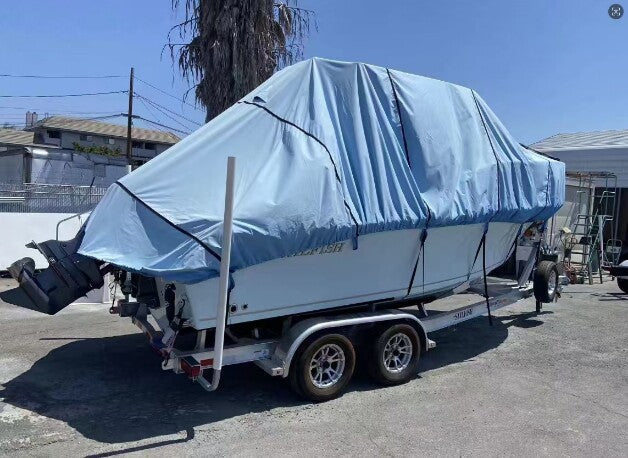
Choosing the right boat cover is essential for protecting your boat from sun exposure, rain, dust, dirt, and other outdoor elements. However, finding a cover that fits properly can be challenging, especially if your boat has a center console, T-top, hardtop, or outboard motor.
Accurate measurements help you identify the right cover size and determine whether a standard cover will meet your needs or whether a custom boat cover is a better solution.
In this guide, Airow Marine explains how to measure your boat, what details to record, and how to prepare the information needed for a custom boat cover.
1. Why Accurate Boat Measurements Matter
A boat cover that is too small may leave important areas exposed, while an oversized cover may create excessive loose fabric that can flap in the wind or collect water.
Taking accurate measurements helps you:
-
Choose a cover that better matches your boat's dimensions.
-
Determine whether the cover can accommodate your center console, T-top, or hardtop.
-
Confirm whether the outboard motor needs to be covered.
-
Reduce the risk of ordering an unsuitable cover.
-
Provide the information needed to discuss a custom-fit solution.
If your boat has an unusual hull shape, additional equipment, or a large outboard motor, measurements and photos are especially helpful when selecting a cover.
2. Prepare Your Boat Before Measuring
Before you begin, prepare a measuring tape, a notepad or phone, and a camera.
Whenever possible, measure your boat while it is parked on a level surface and positioned safely.
Before taking measurements:
-
Remove loose items that could interfere with measuring.
-
Identify the boat's main hull dimensions and highest fixed structures.
-
Decide whether you want the cover to include the outboard motor.
-
Identify any accessories that the cover must fit around or accommodate.
For the best results, take clear photos of your boat from the front, rear, both sides, and above if possible. These photos can help clarify the boat's shape and the arrangement of its equipment.
3. Measure the Overall Length of Your Boat
Start by measuring the overall length of the area you want the cover to protect.
For a typical boat, measure from the forward end of the bow to the rear of the hull. Record the measurement in inches or feet.
It is important to distinguish between the boat's advertised length and the actual area that needs to be covered. Published boat lengths may exclude certain accessories, and different manufacturers may define overall length differently.
If you want the cover to extend over an outboard motor, record the motor's position and dimensions separately. Do not assume that the boat's advertised length automatically includes the motor.
Tip: Record both the manufacturer's stated boat length and your actual measurements. This gives the cover supplier more information when evaluating fit.
4. Measure the Beam or Maximum Width
The beam is the boat's maximum width.
Measure across the widest part of the hull, from one side to the other. Keep the measuring tape level and record the location where the maximum width occurs.
For boats with a center console, T-top, or hardtop, the hull beam may not represent the full width of the equipment that the cover needs to accommodate.
If necessary, take additional measurements for:
-
The widest point of the hull.
-
The width of the center console or other raised structures.
-
The width and position of a T-top or hardtop.
-
Any side-mounted equipment that affects the desired cover shape.
These additional dimensions can help determine whether a standard cover is suitable or whether a custom design should be considered.
5. Account for a Center Console, T-Top, or Hardtop
Boats with raised structures often require more careful cover planning than open boats.
A center console, T-top, or hardtop can change the cover's shape, height, and required coverage area. A cover designed for a conventional open boat may not fit properly around these structures.
When measuring your boat, record:
-
The length and width of the center console or raised structure.
-
Its position relative to the bow and stern.
-
The height of the structure above the deck.
-
The dimensions and position of any fixed supports.
-
Any sharp corners or protruding accessories that could affect the cover.
For a T-top or hardtop boat, also clarify whether you want the cover to fit around the structure, extend over it, or cover the boat according to a particular design.
Do not assume that every cover advertised for a T-top or hardtop boat will fit every model. Confirm the intended coverage and compatibility before ordering.
6. Decide Whether the Outboard Motor Should Be Covered
If your boat has an outboard motor, decide whether you want the cover to protect the motor as well as the boat.
This is particularly important if your boat is stored outdoors or transported on a trailer.
If you want the cover to extend over the motor, record:
-
The distance from the rear of the hull to the outermost point of the motor.
-
The approximate width of the motor.
-
The height of the motor in the position in which it will be covered.
-
The desired coverage along the sides and rear of the boat.
Take rear and side photos showing the motor in its intended covered position.
A cover that protects the hull alone may not provide full outboard coverage. Be sure to communicate your requirements before requesting a quote.
7. Consider How You Will Use and Store Your Boat
The intended use of your boat cover also affects the design requirements.
Outdoor Storage
For outdoor storage, consider the expected sun exposure, rain, and general weather conditions in your area. Look for suitable marine-grade fabric, appropriate water resistance, and construction designed for outdoor use.
Trailering
If you plan to tow your boat with the cover installed, choose a cover specifically designed and rated for trailering. Confirm the manufacturer's recommendations for installation, tie-downs, and allowable towing conditions.
Not every storage cover is suitable for road use.
Custom Coverage
If you need the cover to extend farther down the sides, accommodate a particular structure, or protect the outboard motor, explain these requirements before placing your order.
Clear expectations about the coverage area help avoid misunderstandings later.
8. Take Photos to Support Your Measurements
Measurements are important, but photos provide additional context that numbers alone may not capture.
For a custom boat cover inquiry, we recommend providing:
-
A front view showing the bow and overall shape.
-
A rear view showing the stern and outboard motor, if applicable.
-
A port-side view and a starboard-side view.
-
An overhead photo, if available.
-
Close-up photos of the center console, T-top, hardtop, supports, and other relevant structures.
If possible, include a measuring tape in the photos to show the dimensions of important areas.
Please ensure that the measurements and photos correspond to the same boat configuration that you want the cover to fit.
9. When Should You Choose a Custom Boat Cover?
A standard boat cover may be suitable when your boat's dimensions and configuration closely match the product's stated specifications.
A custom boat cover may be worth considering if:
-
Your boat has an unusual hull shape or dimensions.
-
You need a specific fit around a center console, T-top, or hardtop.
-
You want the cover to extend over the outboard motor.
-
You need a particular side-drop or coverage length.
-
Standard covers do not meet your protection requirements.
Before ordering, compare your measurements with the product specifications and confirm any important fit requirements with the supplier.
10. Explore Our Center Console Boat Cover
Airow Marine offers a center console boat cover designed for boats in the 18–20 ft range, with product information addressing trailerable boats and T-top or hardtop configurations.
You can view the product and review its specifications here:
Shop Our Center Console Boat Cover for 18–20 ft Boats
Please review the listed specifications carefully before ordering. Boat dimensions and equipment configurations vary, so the advertised length range alone does not guarantee compatibility with every boat.
11. Need a Custom Boat Cover? Contact Airow Marine
If you cannot find a standard cover that meets your needs, Airow Marine can discuss your requirements and help determine whether a custom solution is suitable.
To help us understand your boat, please include the following information in your email:
-
Boat brand, model, and model year.
-
Overall boat length and maximum beam.
-
Whether your boat has a center console, T-top, or hardtop.
-
Whether the outboard motor needs to be covered.
-
Your preferred coverage length and any special requirements.
-
Clear photos of the boat from several angles.
Email our customer service team: sales@airowmarine.com
Our team can review the information you provide and discuss the next steps for a custom boat cover inquiry.
Frequently Asked Questions
How do I know what size boat cover I need?
Start with the manufacturer's stated boat length and beam, then compare those dimensions with the cover's specifications. Also consider raised structures, outboard motor coverage, and the actual area you want to protect.
Can I use a standard cover for a boat with a T-top?
It depends on the cover's design and the dimensions of your boat. Confirm that the product is intended for your specific configuration and check how the cover accommodates the T-top and its supports.
Should the outboard motor be included when measuring boat length?
Record the hull length and the outboard motor dimensions separately. If you want the motor covered, tell the supplier and provide photos so the required coverage can be evaluated.
What information should I send when requesting a custom boat cover?
Provide your boat's brand, model, model year, dimensions, equipment configuration, desired coverage, and clear photos. Additional measurements may be requested after the initial review.
Can I request a cover that extends farther down the sides of my boat?
You can explain your preferred side coverage when contacting the supplier. The feasibility will depend on the boat's dimensions, cover design, and manufacturing requirements.
Final Thoughts
Accurate measurements are the first step toward choosing a boat cover that meets your needs. By recording your boat's dimensions, identifying its fixed structures, deciding whether the outboard motor should be covered, and taking clear photos, you can make the selection process easier.
Explore the Airow Marine center console boat cover, or email sales@airowmarine.com if you need assistance discussing a custom boat cover for your boat.

Leave a comment
This site is protected by hCaptcha and the hCaptcha Privacy Policy and Terms of Service apply.