
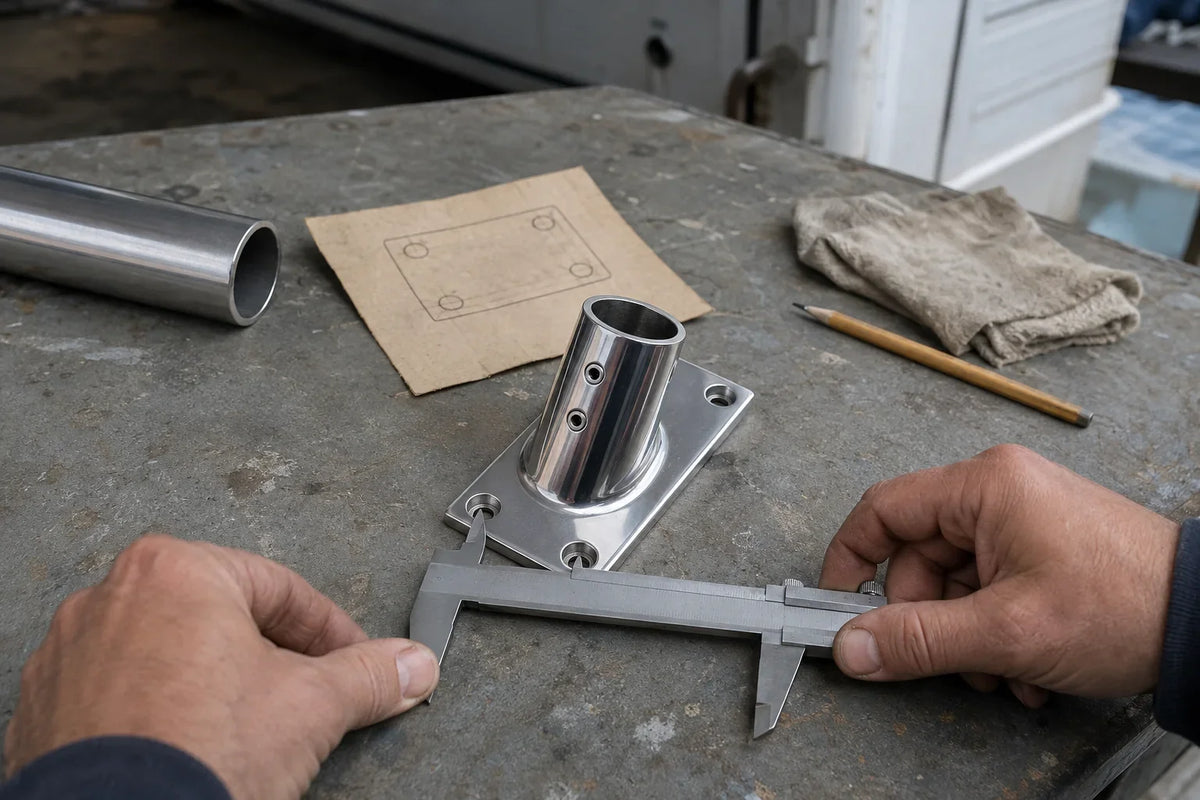
Cover image note: This AI-generated technical illustration shows representative hardware, a caliper and a hole-pattern template. No measurement value should be read from the image; record dimensions from the actual part.
If you want a useful answer to “will this marine fitting fit?”, send a measurement set that shows the part, the hole and the structure. A close-up of polished metal is rarely enough.
The six-photo request
- Context: stand back and show where the fitting lives on the boat.
- Square-on top view: include a ruler in the same plane as the base.
- Side view: show height, offset, lid gap or tube direction.
- Open or operating view: show hinge swing, latch cam, folded cleat or moving joint.
- Underside: show nuts, washers, backing, liner and access.
- Old part removed: show the hole pattern, cutout and any water or substrate damage.
Keep the ruler straight and close to the feature. If perspective is unavoidable, photograph the same measurement twice from opposite directions. Do not rely on a phone's automatic measurement for the final drilling dimension.
Write down these numbers
- overall length, width and height;
- tube or shaft outside diameter;
- cutout length, width or diameter;
- hole diameter and center-to-center spacing;
- panel or deck thickness;
- clearance above, below and through the full moving arc;
- fastener type, thread and usable length where known.
Also name the boat year, builder and model, but treat that as context rather than proof. Production changes and earlier owner repairs can make a supposedly model-specific answer wrong.
Describe what failed
“Broken” is not a diagnosis. Say whether the part cracked, loosened, seized, leaked, rattled, pulled through the deck or stopped aligning. Photograph staining before cleaning and show any elongated holes. The failure mode may point away from a direct like-for-like replacement.
Do not order until you know the hidden side
A replacement base can cover the old footprint yet leave no room for nuts. A longer screw can enter wiring. A new hole can open wet core. If access is hidden by a liner, find the boatbuilder's service information or ask a qualified technician before drilling.
When comparing a fitting such as a 90-degree rail base, match the live dimensional drawing to your written record. Material and nominal tube size are only two fields in that comparison.
What a seller should be able to answer
With a complete record, the response should separate three things: dimensions confirmed by the product listing, observations visible in your photographs, and installation judgments that require the boat or a professional inspection. Be cautious if a confident fit guarantee is offered from one image.
Why this matters: Hardware replacement often includes opening and resealing deck penetrations. Review BoatUS guidance on rebedding deck hardware before assuming the task is a simple swap.


Leave a comment
This site is protected by hCaptcha and the hCaptcha Privacy Policy and Terms of Service apply.