
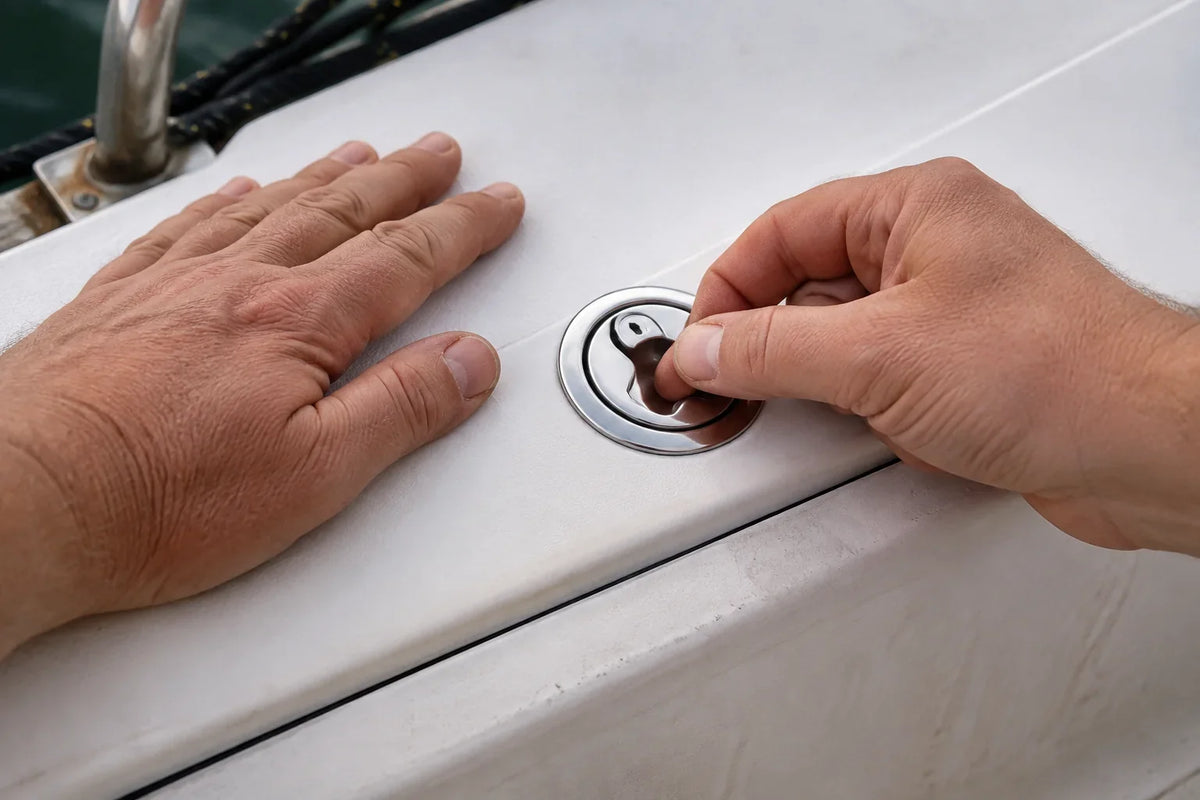
Cover image note: This AI-generated technical illustration shows a reference-based flush hatch latch during a compression check. It is not a customer repair photograph or a dimensional specification.
A rattling hatch does not automatically need a stronger latch. The noise may come from a compressed gasket, a loose hinge, a moving striker, an oversized cutout or a lid that no longer lands squarely. Diagnose the motion before buying the part.
A two-person rattle test
With the boat secure, have one person move the closed lid gently in four directions while the other watches the hinge, latch body, striker and frame. Note which surfaces move relative to each other.
- Vertical movement at the latch side: inspect gasket compression, cam/grip setting and striker position.
- Sideways movement: inspect hinge play and whether the latch is being asked to center the lid.
- Entire frame moving: inspect mounting fasteners, substrate and bedding.
- Handle or cam alone rattling: inspect wear and the maker's adjustment or service procedure.
Measure the installation, not just the face
For a flush or compression latch, record face diameter or outline, cutout dimensions, panel thickness, available depth, cam length, grip range, striker location, locking function and handle clearance. Photograph the back of the latch with a ruler visible. Two latches with identical polished faces can have incompatible bodies and cams.
AirowMarine examples include a flush-pull slam-latch form, an internal turning-lock form, and an external anti-rattle form. These illustrate different mechanisms; verify the live drawing and measure your panel before selecting one.
Compression is controlled, not maximum
A compression latch draws a panel toward its frame through a defined grip range. Too little compression can leave movement or a leak path. Too much can permanently deform the gasket, bow the lid, overload the cam or make release difficult. The correct target comes from the gasket and latch instructions—not from how hard the handle can be forced.
Correct causes in order
- Clean the landing surfaces and inspect the gasket for hard spots, tears and permanent set.
- Confirm hinge fasteners and pin condition. The lid should arrive at the frame squarely without the latch.
- Check latch and striker fasteners, holes and backing.
- Adjust only within the mechanism's intended range.
- If replacement is needed, dry-fit through the full opening and closing arc before bedding.
Do not grind a cam, bend a striker or enlarge a cutout until you have confirmed the model's installation limits. A modification that fixes a rattle at the dock may prevent emergency opening or create a sharp, highly loaded edge.
Acceptance check
The lid should close without being pushed sideways, the handle should complete its travel without excessive force, gasket contact should be even, and the latch should release predictably. Water-test in a controlled way appropriate to the opening, then reinspect after vibration and temperature changes during the next trip.
Source and limits: Selection criteria were checked against Southco's compression-latch questions. This article does not establish a universal grip range, compression value or watertight rating.


Leave a comment
This site is protected by hCaptcha and the hCaptcha Privacy Policy and Terms of Service apply.